


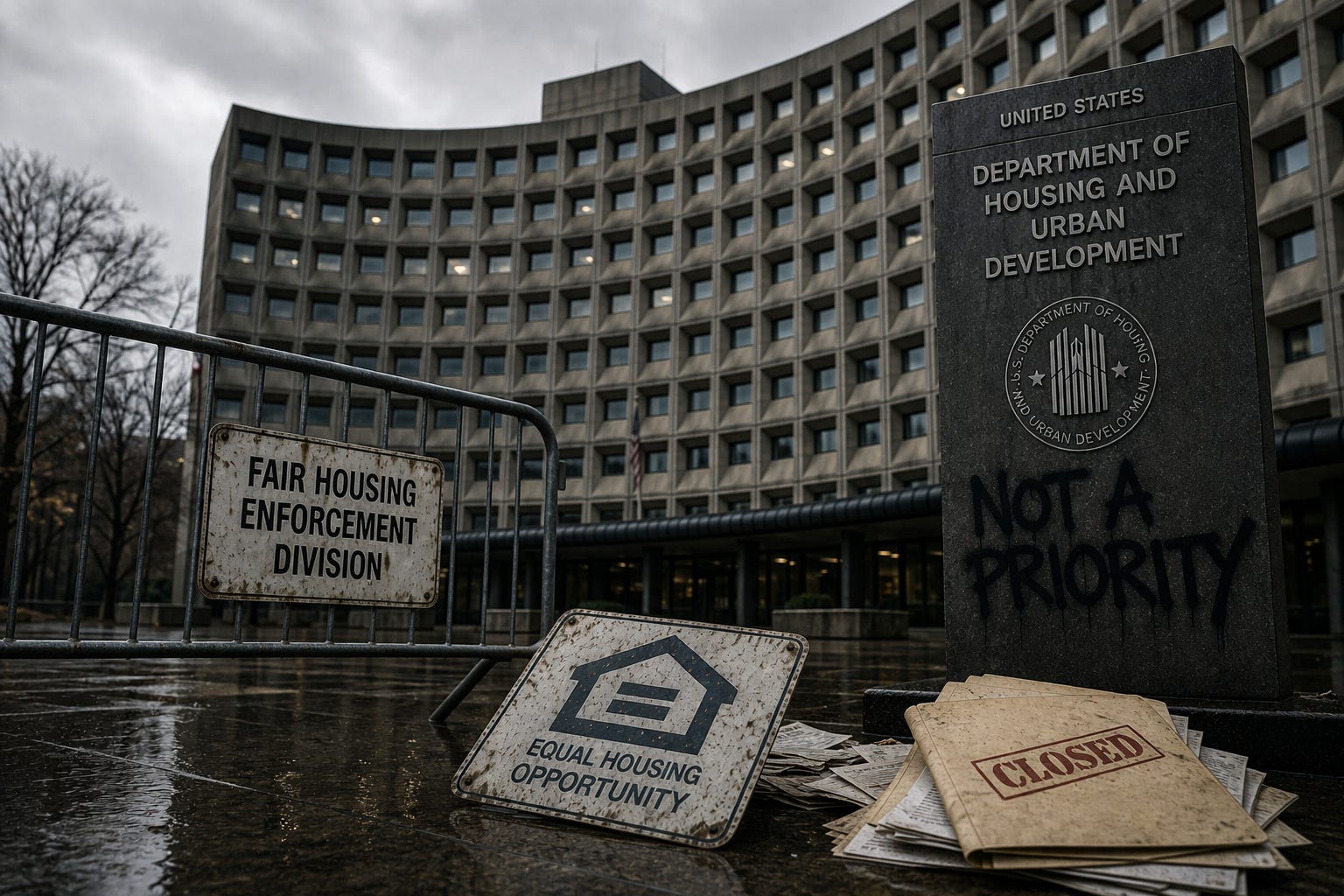
Fair Housing Meter debuted at 30% on April 30, the last day of Fair Housing Month, based on a variety of factors pointing to the gloomy state of fair housing and equal opportunity. One major development is the internal dissent and obstruction occurring at the very agency charged with primary enforcement of the Fair Housing Act.
There have been signs for months that something was not functioning normally within the U.S. Department of Housing and Urban Development (HUD). Those signs were mainly through sporadic reports of stalled cases, funding denials, quiet departures, and concerns raised behind the scenes. But the issue came into sharper focus with the recent launch, during Fair Housing Month, of Dear America, a platform publishing firsthand accounts from “current and former federal workers, as well as surrogates and allies,“ revealing what they have observed within the agency.
Paul Osadebe, one of the site’s founders, told NPR that HUD is being blocked from “being allowed to help the people that we’re supposed to be serving,” adding that “you’re just not allowed to touch” certain cases, such as those related to race or sex.
The collection of letters portrays an upside-down system in which enforcement appears to run against the grain of HUD’s mission. One former supervisor recounts being forced into “heart wrenching choices,” including whether to “[w]ithdraw a case and leave the victims without assistance or lose my job” or “[f]ire an attorney whose career was just getting started or face punishment.” Another employee, who joined HUD’s Fair Housing and Equal Opportunity (FHEO) team because the work was “meaningful and impactful,” explains “we are effectively telling complainants that their pain and suffering is not worth addressing and remedying.”
Another HUD employee warns that the administration is aiming to “dismantle our institutions based on a false assumption. The HUD leadership continues “perpetuating the dangerous myth that HUD employees are lazy, inefficient, and do not care.” As a result, “the American public has, and will continue, to be hurt.”
“Their pain and suffering is not worth addressing and remedying.”
Across multiple letters, a consistent pattern emerges. Employees describe being instructed to avoid certain categories of cases or receiving clear signals to steer clear of particular types of discrimination claims. As a result, entire protected classes remain exposed through internal direction and pressure.
While these allegations are not all independently verified, they are serious and consistent. Given that they are coming from inside HUD, often from career staff involved directly with enforcement, they appear highly credible.
Fair housing depends not only on the existence of legal protections, but on whether those protections are actively enforced under the law. Fair housing enforcement can fail not only when laws are repealed but when government leadership obstructs and delays after devaluing the principles guiding the enactment of the civil rights laws to begin with.
Fair Housing Meter’s readings are not based just on whether statutory language changes but on a holistic assessment of fair housing and equal opportunity in America. This disturbing new insight into HUD, particular as it regards housing discrimination, is an urgent reminder that the strength of fair housing protections depends not just on what the law says, but on whether it is carried out. When HUD fair housing enforcement duties get actively curtailed and sidelined as part of a sustained campaign from the top, it contributes to a reading as low as 30%.