


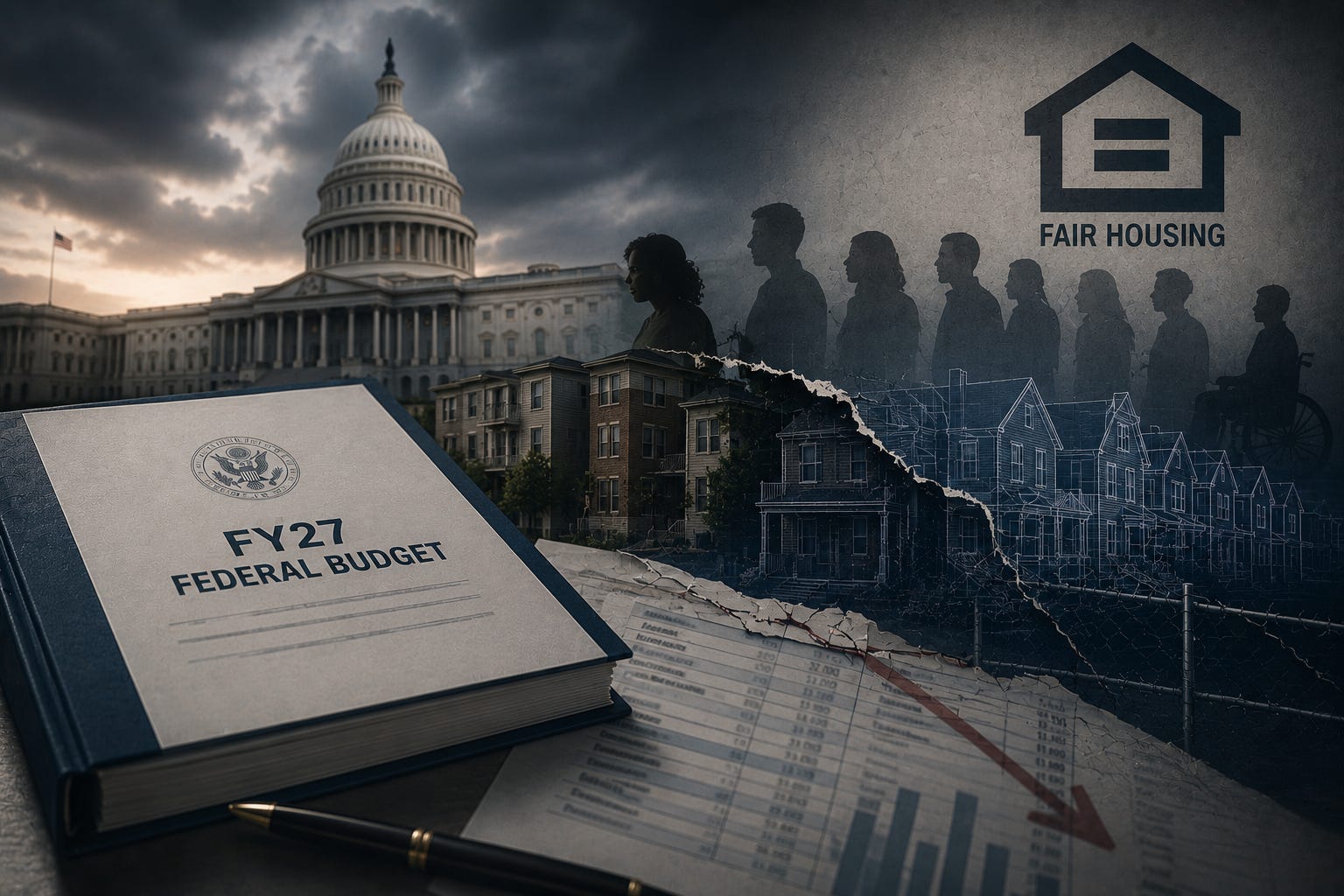
Fair Housing Meter debuted at 30% on April 30, the final day of Fair Housing Month, reflecting a broad range of developments pointing to the unusually weakened state of fair housing and equal opportunity in the United States. One major factor was the Trump administration’s proposed FY27 federal budget, which proposes deep cuts to housing and fair housing programs at a time when combating discrimination and addressing affordability remain critical.
The timing was striking given that it was Fair Housing Month, when the nation commemorates passage of the Fair Housing Act of 1968 and reflects on the unfinished work of equal housing opportunity. Revealing an increasingly hostile attitude toward fair housing and civil rights in general, the administration proposed a budget that would dismantle significant portions of the nation’s fair housing infrastructure and threaten to turn back the clock even further when it comes to honoring longstanding laws and their protections.
Among the most consequential proposals is the elimination of the Fair Housing Initiatives Program (FHIP), a Reagan-era HUD program that funds nonprofit fair housing organizations across the country. These organizations investigate discrimination complaints, conduct testing, educate the public about housing rights, assist victims of discrimination, and support enforcement of the Fair Housing Act. According to the National Fair Housing Alliance’s analysis of the proposal, FHIP has historically served as a cost-effective public-private enforcement model dating back to the Reagan administration.
The proposal would also eliminate funding for the National Fair Housing Training Academy and reduce or eliminate other fair housing-related activities, including language-access support and education initiatives. The administration’s budget documents specifically criticized some organizations receiving fair housing grants, accusing them of promoting political or ideological positions opposed by the administration.
The proposed reductions extend far beyond fair housing enforcement alone. Housing advocates and policy organizations have warned that the FY27 proposal would significantly weaken affordable housing, homelessness assistance, and community development programs more broadly. Analyses of the proposal note that while some rental assistance programs avoided the dramatic reductions seen in certain previous budget cycles, the proposal still relies heavily on cuts, flat funding, and policy changes that could reduce access to housing assistance over time.
The timing was striking given that it was Fair Housing Month, when the nation commemorates passage of the Fair Housing Act of 1968 and reflects on the unfinished work of equal housing opportunity.
Meanwhile, fair housing advocates and housing organizations have continued raising concerns about funding instability, staffing pressures, and reduced federal support for civil rights enforcement and affordable housing programs.
Importantly, the President’s budget proposal is not the final federal budget. Under the congressional appropriations process, Congress ultimately determines spending levels. The federal fiscal year begins on October 1, and Congress must pass appropriations legislation before then or enact a temporary continuing resolution to avoid a government shutdown. House appropriators have already begun work on FY27 spending bills, including HUD-related appropriations measures expected to move through committee during the spring and summer.
That distinction matters because presidential budget proposals often function not only as financial blueprints, but also as statements of priorities and governing philosophy. For decades, Congress has considered proposed cuts to housing programs. However, even before Congress has an opportunity to act, an administration’s budget proposal broadcasts important signals. A budget reveals the programs and underlying policies that an administration values, and who should benefit from federal support.
The FY27 proposal does not read as merely a routine policy disagreement over spending levels. Instead, it fits into a broader pattern involving grant cancellations, internal disruption at HUD, reduced staffing and enforcement capabilities, and growing hostility toward civil rights-oriented initiatives, as discussed in a recent post. These developments help explain why Fair Housing Meter debuted at only 30%.
The next several months will determine how much of the administration’s proposal survives the congressional process. But regardless of the ultimate appropriations outcome, the Trump administration’s FY27 budget proposal stands as a display of its stark lack of commitment to fair housing and equal opportunity in the United States.